
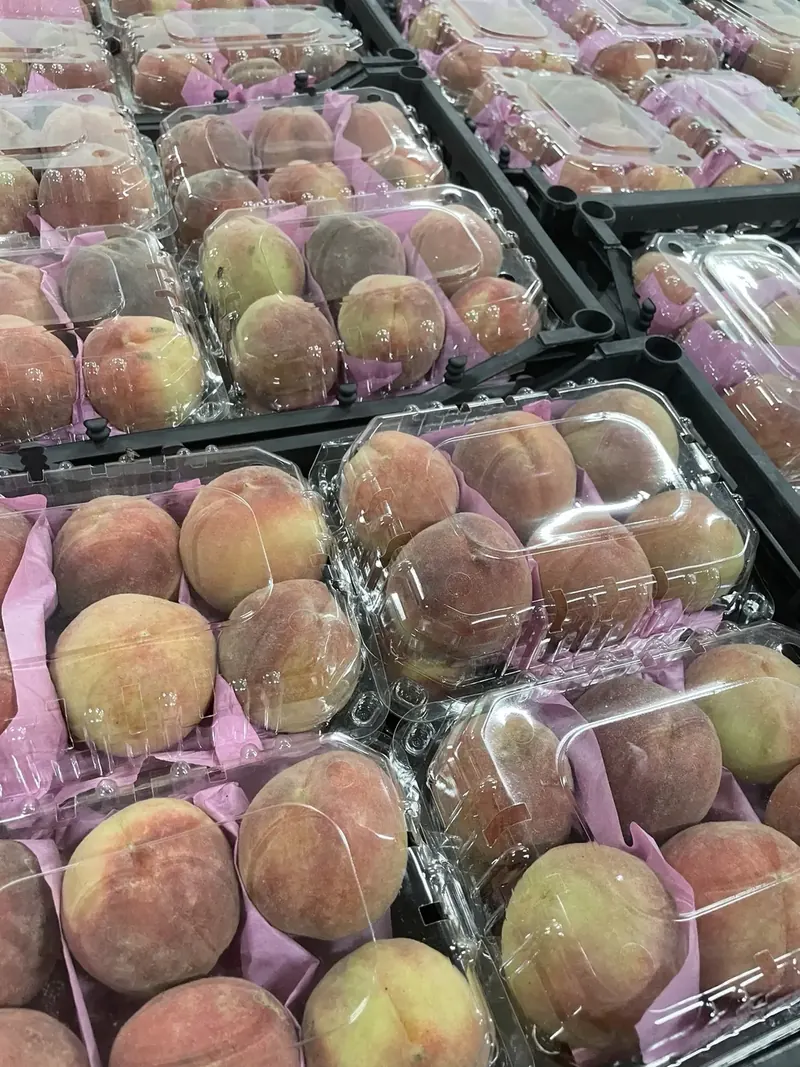
Egypt’s warm spring allows peaches to ripen earlier than in most Mediterranean countries. The season is short — typically April to June — but it arrives at a moment when many retailers are looking for the first stone fruit of the year.
Early-season varieties
Egyptian export peaches are early-season, low-chill varieties adapted to mild winters. Varieties change with the season and are confirmed per order. Early peaches are usually smaller than mid-season fruit, with a bright colour and a fresh, slightly tart flavour. Setting realistic size expectations for the first weeks avoids disappointment on arrival.
What to specify
- Size — by diameter or fruit count per pack.
- Colour — percentage of red blush on the skin.
- Firmness — measured with a penetrometer; firmness at harvest is matched to transit time.
- Brix — a minimum sugar level protects eating quality.
- Tolerances — bruising, split stones, skin marks and decay.
Packing formats
- Retail clamshells in master cartons, labelled for supermarkets.
- Wholesale crates for short routes and regional markets.
- Private label, label language and barcode by agreement.
Firmness planning
Peaches soften fast once harvested. For sea freight, fruit is picked firmer; for air freight or trucking to nearby markets, it can be picked riper and tastier. We agree the target firmness with each buyer based on route and shelf life.
Cold chain
Peaches are carried cold, typically −0.5 to +1 °C at 90–95% relative humidity, after fast pre-cooling. Some peach varieties can develop mealy or woolly texture if held too long in an intermediate temperature range, so it is important to cool quickly and keep the set-point stable.
Why buy Egyptian peaches
- An early window before the main Mediterranean harvest.
- Short sea and air routes to Europe and the Gulf.
- The possibility to combine peaches with the end of the strawberry season and the start of grapes.
Egyptian peaches are about timing. Plan the window, agree the firmness, and keep the cold chain tight.
See specifications and availability on our Egyptian peaches page.
Frequently asked questions
When are Egyptian peaches available?
In spring, typically from April to June, depending on variety and weather.
Are Egyptian peaches smaller than European peaches?
Early-season fruit is often smaller than mid-season fruit, so size expectations should be agreed in advance.
How are peaches packed?
In retail clamshells in master cartons, or wholesale crates for short routes.
What temperature are peaches carried at?
Typically −0.5 to +1 °C at 90–95% relative humidity.