
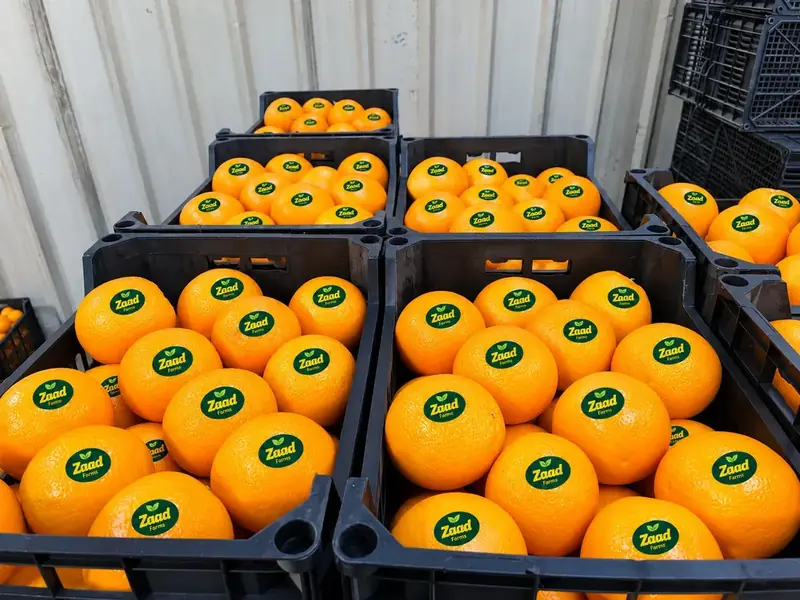
Egyptian mandarins cover almost six months of the year. By moving from one variety to the next, an importer can keep an easy-peeler on the shelf from November to April from a single origin. This guide lists the main varieties, their windows and the specification points that matter most.
Variety calendar
| Variety | Window | Character |
|---|---|---|
| Clementine | November – January | Seedless or low-seed, very easy to peel |
| Fremont & Mirav | December – February | Deep orange colour, sweet flavour |
| Murcott | January – April | Rich flavour, thin skin, travels well |
| Minneola | January – March | Tangelo type with a neck, juicy and aromatic |
Murcott is the main Egyptian export mandarin. It has a rich, sweet-tart flavour and a thin skin that holds up well on voyages to Europe, the Gulf and Russia. Clementines open the season and are prized for easy peeling. Fremont and Mirav bridge the gap with strong colour, while Minneola offers a distinctive shape for speciality programmes.
Counts and sizes
Mandarins are also sized by count per carton. Common counts are 30, 36, 42, 48, 54, 63 and 72. Retail programmes in Europe usually work in the middle of the range; wholesale and price-driven programmes accept smaller fruit. As with oranges, ask for a range of counts to improve availability.
What to specify beyond size
- Seeds — Murcott can contain seeds depending on the orchard and pollination; if you need low-seed fruit, say so.
- Colour — early fruit may be less coloured; agree whether degreening is acceptable.
- Puffiness and skin — easy-peelers can become puffy late in the season; set tolerances for skin condition.
- Leaves — leafy Clementines are a premium item in some markets and need careful handling.
- Brix and acidity — useful for premium retail; agree the method of measurement.
Packing formats
- 8 kg corrugated carton — the standard for European and Gulf retail, packed by count.
- 9 kg ventilated plastic crate — for wholesale markets and short chains.
- Retail packs — nets or small boxes in master cartons, on request.
Private-label cartons and bags are available with your brand and barcode. Cartons are built on Euro or industrial pallets with corner boards and pallet labels.
Carrying conditions
Mandarins are more delicate than oranges. The carrying temperature is confirmed per variety, typically between +4 and +7 °C, with 90–95% relative humidity. Pre-cooling after packing and a stable set-point during the voyage reduce skin breakdown and weight loss. If your market requires cold treatment, it is planned before loading.
Mixed loads with oranges
Many importers combine mandarins with oranges or grapefruit in one reefer. This is possible when the set-points are compatible. If they are not, a mixed load forces a compromise that usually harms the more sensitive product — so agree the set-point first, then the mix.
Plan the season as a relay: Clementine, then Fremont and Mirav, then Murcott until April.
See current availability on our Egyptian mandarins page, or compare with oranges. For a full view of Egypt’s seasons, see the seasonal calendar.
Frequently asked questions
Which Egyptian mandarin is best for export?
Murcott is the main export variety thanks to its flavour and thin, durable skin. Clementines are preferred early in the season for easy peeling.
When are Egyptian mandarins available?
From November to April: Clementine first, then Fremont and Mirav, then Murcott until April.
What is the standard mandarin carton?
An 8 kg corrugated carton packed by count. 9 kg plastic crates and retail packs are also available.
Can mandarins travel with oranges in one container?
Yes, when the agreed set-points are compatible. Otherwise it is better to ship them separately.