
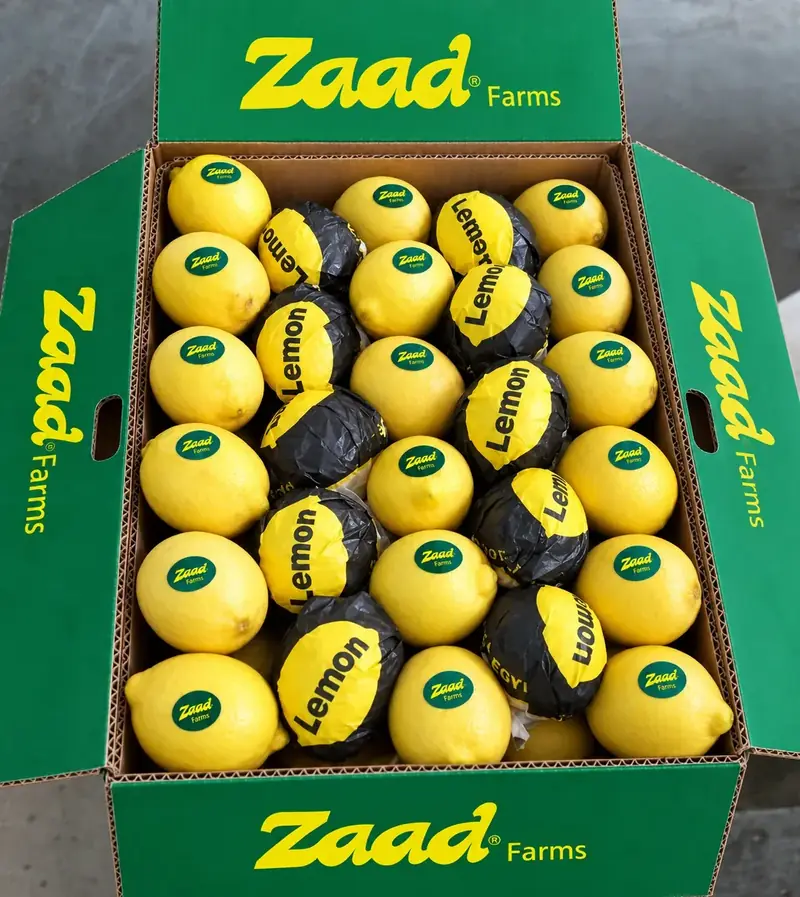
Lemons are a year-round necessity for retailers and foodservice, and Egypt fills an important part of the calendar, from September to March, with a peak from November to February. Our export lemon is the Eureka type: medium-sized, juicy, with a smooth, bright yellow skin.
Season and colour
Early-season lemons in September and October can still show green areas. Some markets accept this; others require full yellow colour, which may involve degreening after harvest. From November, natural colour is usually complete. Tell us your colour requirement, so we can plan harvest and post-harvest handling accordingly.
Sizes (counts)
Lemons are sized by the number of fruits in a 15 kg carton. Common counts are 80, 88, 100, 113, 125 and 138.
- 80–100 — larger fruit for retail and bars or restaurants that slice lemons.
- 113–138 — smaller fruit for price-driven retail, nets and processing.
Loose or individually wrapped?
Lemons can be packed loose by count, or each fruit can be wrapped in printed tissue paper. Wrapping has three benefits: it reduces the spread of decay from one fruit to another, it slows moisture loss on long voyages, and it gives a premium presentation. It also adds cost and packing time. We generally recommend wrapped fruit for long voyages and premium retail, and loose fruit for short routes and foodservice.
Packing formats
- 15 kg telescopic or open-top carton, packed by count.
- Individually wrapped fruit in printed tissue, including your own brand.
- Ventilated crates for wholesale.
- Consumer nets in master cartons for supermarkets.
Quality points to agree
- Colour at shipment (fully yellow or light green accepted).
- Skin texture and thickness — thin, smooth skin gives more juice.
- Juice content, if you sell to foodservice or processors.
- Tolerances for wind scars and minor skin marks.
- Firmness on arrival.
Cold chain
Lemons are sensitive to chilling injury at very low temperatures, but they also lose firmness if carried too warm. A typical set-point is +3 to +5 °C at 85–90% relative humidity, confirmed per programme and voyage length. Pre-cooling before loading and good airflow through the pallets are important. See our reefer guide for the principles.
Lemons and limes together
Many buyers combine lemons and green limes. Limes are usually carried warmer, so a mixed load needs a compromise set-point or separate containers. Discuss this before booking.
For long voyages, wrapped Eureka lemons at the right temperature arrive firmer and cleaner than loose fruit.
Specifications and availability are on our Egyptian lemons page. For documents and residue limits, read our MRL and phytosanitary guide.
Frequently asked questions
When is the Egyptian lemon season?
From September to March, with a peak from November to February.
What lemon variety does Egypt export?
Our export lemons are the Eureka type: juicy, medium-sized fruit with smooth yellow skin.
Why are some lemons individually wrapped?
Wrapping reduces the spread of decay and moisture loss on long voyages and gives a premium look.
What sizes are available?
Counts 80, 88, 100, 113, 125 and 138 per 15 kg carton.