
Grapefruit and limes are smaller lines than oranges and mandarins, but they complete a citrus programme. For many importers, adding them to an Egyptian orange supply means fewer suppliers and fuller containers. This guide covers both.
Grapefruit: a short winter window
Egyptian grapefruit is exported mainly from November to January, with December as the typical peak. We supply red-fleshed types, including Star Ruby. Red grapefruit is valued for its colour, sweeter taste and lower bitterness compared with white types.
Grapefruit sizes
Grapefruit is sized by count per 15 kg carton: 30, 36, 40, 42, 48, 56, 64 and 72. Lower counts mean larger fruit. European retail typically buys in the middle of the range.
Grapefruit packing
- 15 kg export carton, packed by count.
- 10 kg plastic crate for wholesale and short chains.
- Private-label cartons on request.
Grapefruit quality points
- Internal colour and Brix for red varieties.
- Skin colour — early fruit may show green patches.
- Shape and skin smoothness; tolerance for wind scars.
- Firmness on arrival.
Limes: fresh green fruit
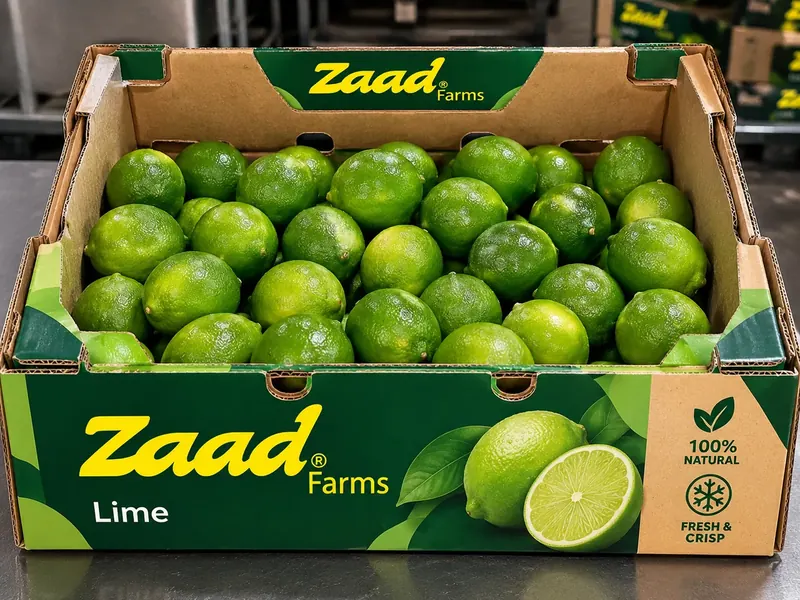
Our limes are fresh green limes packed in printed export cartons, with net weight and grading agreed per order. Limes are prized for colour and juice. The two most common complaints on arrival are yellowing and dry fruit, so both harvest maturity and cold chain matter.
Lime packing
- Export carton packed by size, with the net weight agreed for your market.
- Retail packs — small nets or packs in master cartons.
- Mixed citrus loads with lemons where conditions match.
Carrying temperatures
| Product | Typical set-point | Relative humidity |
|---|---|---|
| Grapefruit | +10 to +13 °C | 85–90% |
| Limes | +9 to +10 °C | 85–90% |
| Oranges (for comparison) | +3 to +5 °C | 85–90% |
Grapefruit and limes are sensitive to chilling injury, so they are carried warmer than oranges. This matters when you plan a mixed load. Grapefruit and limes are compatible with each other; putting them with oranges forces a compromise. Final set-points are always confirmed per programme.
Building a citrus programme
A practical winter programme from Egypt might combine Navel oranges, Clementines and grapefruit in December, then Valencia oranges, Murcott mandarins and lemons from February. Limes can be added where volumes justify it. One supplier, one set of documents and one quality standard across the range simplify the whole season.
See specifications on our grapefruit and limes pages, or read the full citrus guide.
Frequently asked questions
When is Egyptian grapefruit in season?
Mainly from November to January, with a typical peak in December.
Which grapefruit varieties do you export?
Red-fleshed grapefruit, including Star Ruby.
Why are limes and grapefruit carried warmer than oranges?
They are more sensitive to chilling injury. Typical set-points are about +9 to +13 °C.
Can I combine limes with lemons?
Yes, where the agreed conditions match. Otherwise a compromise set-point or separate container is needed.