
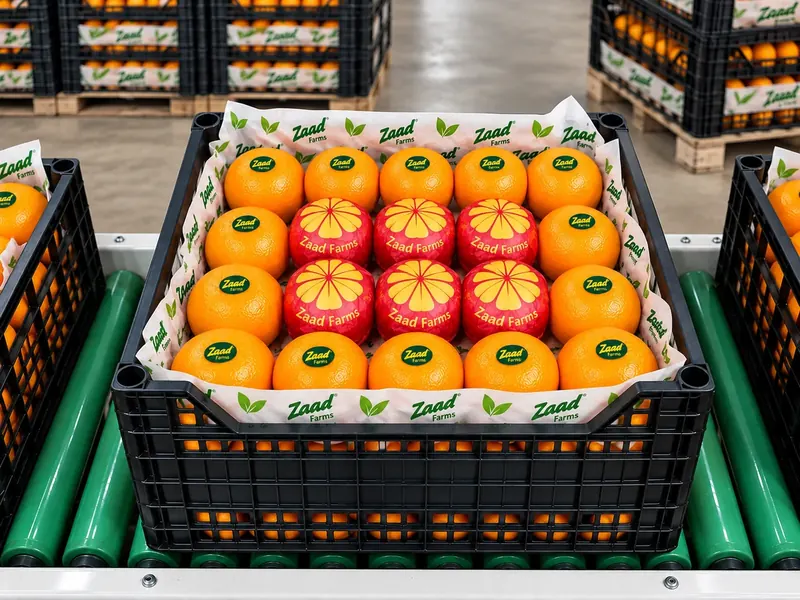
Egypt is one of the world’s leading citrus exporters, and Egyptian Valencia oranges are a staple in markets from Rotterdam to Riyadh and Moscow. This guide summarises the main varieties, seasons, sizes and packing options, so you can write a clear specification.
Oranges: Navel and Valencia
Navel oranges are harvested from December to February. They are seedless and easy to peel, ideal for early-season fresh retail. Valencia oranges run from February to May and are the backbone of Egyptian exports: sweet, juicy, with a thin, firm peel that handles long voyages well.
Oranges are sized by count — the number of fruit in a 15 kg carton. Common counts range from 42 (large) to 125 (small). European retail typically buys 56–88, while some Gulf and Asian buyers prefer larger fruit.
Mandarins
Egyptian mandarins cover November to April. Clementines open the season; Murcott is the main export variety from January to April thanks to its flavour and shelf life. Fremont, Mirav and Minneola complete the range. Mandarins are packed by count, commonly in 8 kg cartons or 9 kg crates.
Lemons and grapefruit
Egyptian Eureka lemons are available from September to March, in counts from 80 to 138, loose or individually wrapped. Red and Star Ruby grapefruit have a short season from November to January.
Packing formats
| Format | Typical use |
|---|---|
| 15 kg telescopic carton | Oranges and lemons, wholesale and retail distribution |
| 10 kg open-top carton | Retail presentation, lighter handling |
| 8 kg carton / 9 kg crate | Mandarins |
| Ventilated plastic crate | Wholesale markets, short supply chains |
| 1–3 kg net bags | Retail promotions, in master cartons |
Agree carton dimensions with your pallet and handling process. A strong-looking carton can still have the wrong footprint for your warehouse.
Carrying conditions
Oranges typically travel at +3 to +5 °C with 85–90% relative humidity and controlled ventilation. Mandarin set-points vary by variety and maturity. Lemons and grapefruit are more sensitive to cold. Some destinations require a cold-treatment protocol for citrus, which sets specific temperatures and durations in transit — confirm this with your importer before booking.
What to put in a citrus specification
- Variety and intended use (fresh retail, wholesale, juice)
- Count range and grade (Class I, Class II)
- Colour and degreening requirements
- Wax or no wax; post-harvest treatment requirements for your market
- Carton type, net weight, label and stickers
- Pallet pattern and cartons per pallet
- Set-point, ventilation and any cold-treatment protocol
Compare citrus quotations on the same variety, count range, net weight and pack — otherwise you are comparing different products.
Frequently asked questions
What does ‘count 72’ mean for oranges?
It means 72 fruits fill a standard 15 kg carton. Lower counts mean larger fruit.
Are Egyptian oranges good for juicing?
Yes. Valencia oranges have high juice content and are widely used by juice processors as well as for fresh retail.
How many cartons of oranges fit in a 40ft reefer?
Typically around 1,500–1,600 cartons of 15 kg on 20–21 pallets, depending on carton size and pallet pattern.