
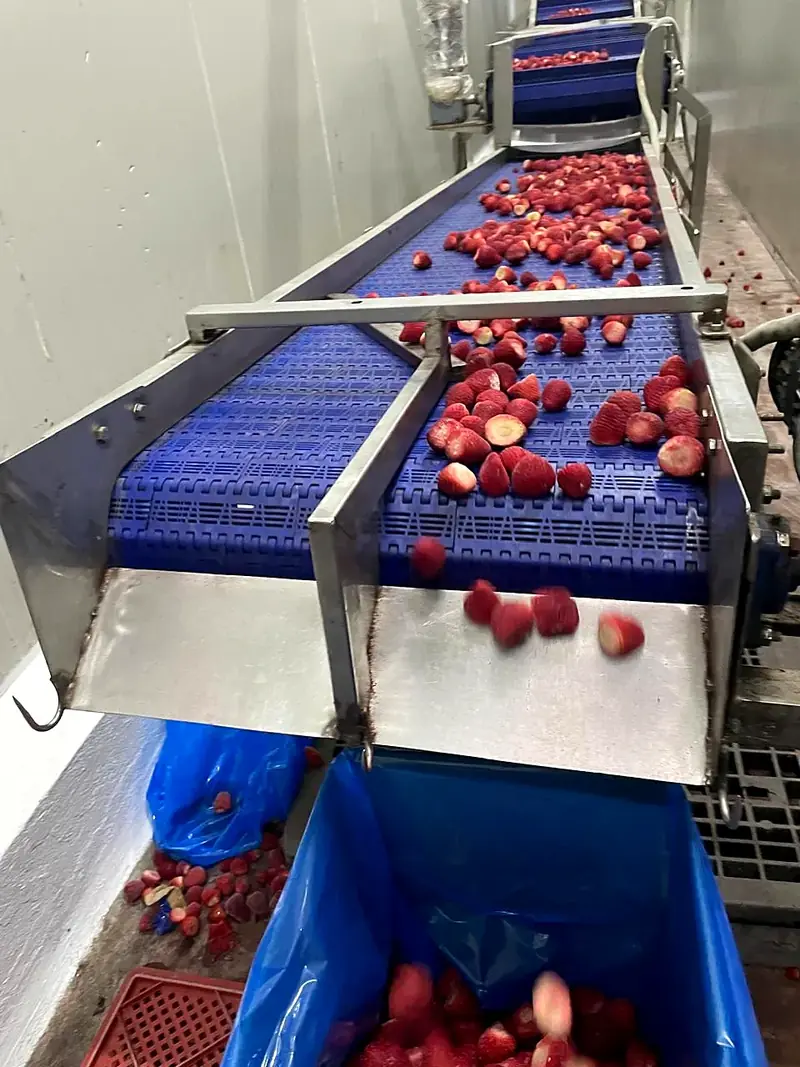
Quick answer: IQF stands for individually quick frozen. Pieces of fruit or vegetable are frozen separately and fast, usually in a stream of very cold air, so they do not clump into a block and ice crystals stay small. The result is free-flowing product that can be portioned from a bag as needed, and typically keeps texture, colour and flavour better than slow freezing, provided the raw material, processing and cold chain are all good. This guide is general information; each product and line works differently, so ask your supplier for its specifications.
What IQF means
In a block freeze, product is packed and frozen as a mass, so pieces stick together and freeze slowly from the outside in. In IQF, each piece is exposed to very cold air or another cooling medium while moving along a belt or in a fluidised bed, so it freezes on its own. Fast freezing forms many small ice crystals rather than a few large ones, and smaller crystals generally cause less cell damage, which supports better texture after thawing. Because pieces stay separate, a user can pour what is needed and return the rest to the freezer.
From field to freezer: the main steps
An IQF line follows a sequence that depends on the product, but the usual stages are as follows. Quality at each step matters, because freezing preserves what you put in; it does not improve it.
| Step | What happens | Why it matters |
|---|---|---|
| Harvest and reception | Fruit or vegetables are picked at the right maturity and brought to the plant quickly | Maturity and freshness set the quality ceiling |
| Sorting and washing | Defects, foreign matter and soil are removed; produce is washed | Food safety and appearance |
| Preparation | Peeling, trimming, cutting or destoning as the product needs | Defines size, shape and grade |
| Blanching (many vegetables) | Brief heat treatment to stop enzymes | Protects colour, flavour and storage life |
| Pre-cooling and drying | Surface water is removed and product cooled | Reduces clumping and ice build-up |
| IQF freezing | Pieces frozen separately in a tunnel or fluidised bed | Small crystals, free-flowing pieces |
| Inspection and packing | Metal detection, final sorting, packing and coding | Safety, grade and traceability |
| Cold storage | Held at a steady very low temperature | Protects quality until shipping |
Which products suit IQF
Many fruits and vegetables work well. Berries such as strawberries, mango pieces, peas, mixed vegetables, okra and many diced or sliced items are common IQF products. Very high-water or delicate products may need special handling, and some products are better frozen in blocks or purées for their end use. For specific examples from Egypt, see our guides to IQF frozen strawberry grades, frozen mango, dates and French fries and frozen okra and molokhia.
What drives quality in the freezer
Several factors influence the finished product. Raw-material variety and maturity come first: a variety bred for fresh sale may not freeze as well as one chosen for processing. Time from harvest to freezing matters, because delays reduce quality. Freezing speed and final core temperature affect crystal size, and the temperature must then be kept steady, because repeated warming and refreezing grows large crystals and causes freezer burn and clumping. Packaging should protect from moisture loss and odours. Many of these steps are described further in our article on blanching and frozen vegetable quality.
Specifications to agree
A frozen purchase is defined by its specification. Typical items include variety, size or cut, grade and defect tolerances, colour, Brix or other analytical values where relevant, foreign-matter limits, moisture and glaze if applied, microbiological limits, pack size and labelling. Agree how product is sampled and measured, and under which conditions it is thawed for assessment, so that results can be compared fairly. Residue and food-safety requirements for your market apply equally to frozen produce, as covered in our guides to residue testing and HACCP and audited schemes.
The cold chain after freezing
Frozen product is only as good as its temperature history. It should be stored and transported at a steady, very low temperature, with loggers in the container where agreed, and handled quickly at each transfer. A break in the cold chain can cause thaw and refreeze, which damages texture and appearance even if the product looks normal when it arrives. See our cold-chain and reefer guide for transport basics, and our notes on frozen fruit for industry for how end users assess incoming lots.
A checklist for frozen buyers
- Ask which varieties and maturity are used for the product you want.
- Confirm the time from harvest to freezing and the process steps.
- Agree a written specification with grades, defects and analytical limits.
- Ask about metal detection and foreign-matter controls.
- Check storage and transport temperatures and request logger data.
- Test a sample for free-flow, colour, texture after thaw and flavour.
- Confirm lot coding and food-safety documents for your market.
IQF freezes quality in place; it cannot add it. Good raw material, quick processing and an unbroken cold chain are what make good frozen fruit.
Frozen products with Zaad Farms
Our frozen range includes frozen strawberries, frozen mangoes, frozen mixed vegetables and frozen okra. Tell us your product, cut and market and we can discuss specifications and what documentation is available. Always confirm technical details and food-safety documents for your market before ordering.
Frequently asked questions
What does IQF mean?
Individually quick frozen: pieces of fruit or vegetable are frozen separately and quickly, usually in very cold air, so they stay loose rather than forming a block.
Why does IQF keep texture better?
Fast freezing forms small ice crystals that cause less cell damage than large crystals from slow freezing, which supports better texture after thawing.
Is blanching always needed for IQF?
Many vegetables are blanched to stop enzymes that affect colour, flavour and shelf life. Most fruit is not blanched. Requirements depend on the product.
What causes clumping in frozen produce?
Moisture on the surface and temperature fluctuations during storage or transport, which cause thaw and refreeze. A steady cold chain and proper drying before freezing reduce clumping.
What should a frozen specification include?
Variety, size or cut, grade and defect limits, colour, analytical values, foreign-matter limits, microbiological limits, pack size and labelling, plus how samples are assessed.
Can Zaad Farms discuss frozen specifications for my market?
Yes. Tell us your product, cut and destination and we will discuss specifications and available documentation. Confirm technical and food-safety details before ordering.