
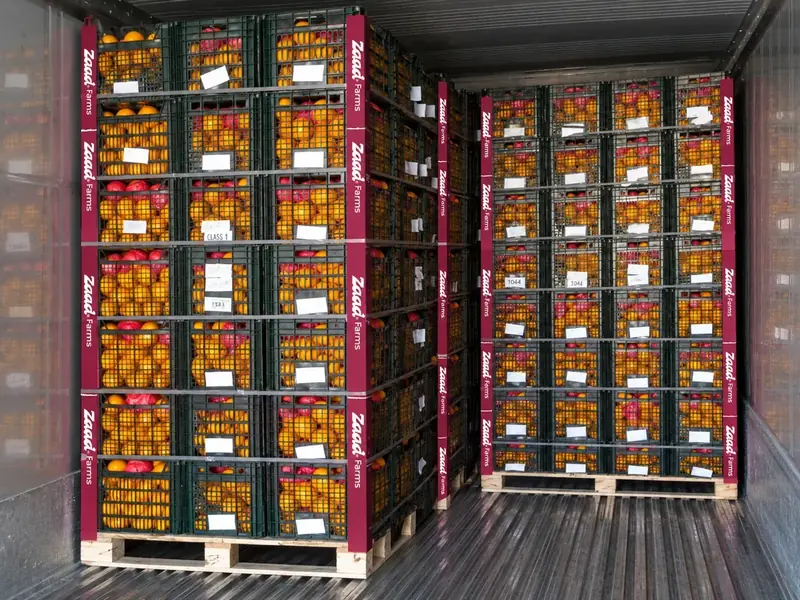
Most Egyptian fruit and vegetables travel by sea in refrigerated containers. Air freight is reserved for highly perishable products, early-season launches and trials. The right choice depends on shelf life, value, volume and how far your market is from Egypt.
Sea freight in reefers
Reefers are 20ft or 40ft containers with their own refrigeration unit. A 40ft reefer typically carries 20–21 pallets. Egypt’s Mediterranean ports give short routes: roughly one to two weeks to North European ports, around a week to the Black Sea, and via the Suez Canal to the Gulf and Asia.
Best for: citrus, potatoes, onions, sweet potatoes, pomegranates, grapes, frozen products — products with enough shelf life for the voyage.
Air freight
Air freight from Cairo reaches Europe and the Gulf within hours. It costs much more per kilo, but gives the longest shelf life on arrival.
Best for: fresh strawberries for premium retail, early-season grapes, guavas and mangoes for specific programmes, samples and trial orders.
Comparison
| Sea (reefer) | Air | |
|---|---|---|
| Transit | Days to weeks | Hours to 1–2 days |
| Cost per kg | Low | High |
| Volume | Full containers | Pallets or cartons |
| Shelf life on arrival | Reduced by voyage | Maximum |
| Temperature control | Continuous, set-point in container | Depends on handling at airports |
How to decide
- Check the product’s shelf life at its ideal temperature.
- Subtract transit time, customs and distribution days.
- Keep enough shelf life for the retailer and consumer.
- Compare landed cost per sellable kilo, not freight cost alone.
Protecting quality on each route
By sea: pre-cool, set the right temperature and ventilation, and use temperature recorders. By air: keep time on the tarmac short, use thermal covers and book cold storage at both airports.
Frequently asked questions
How many pallets fit in a 40ft reefer?
Typically 20–21 standard pallets, depending on pallet size and loading pattern.
Which Egyptian products usually go by air?
Fresh strawberries for premium retail, early grapes and some guava and mango programmes, plus samples.
Is sea freight always cheaper?
Per kilo, yes. But compare landed cost per sellable kilo: for very perishable products, air freight can reduce waste.