
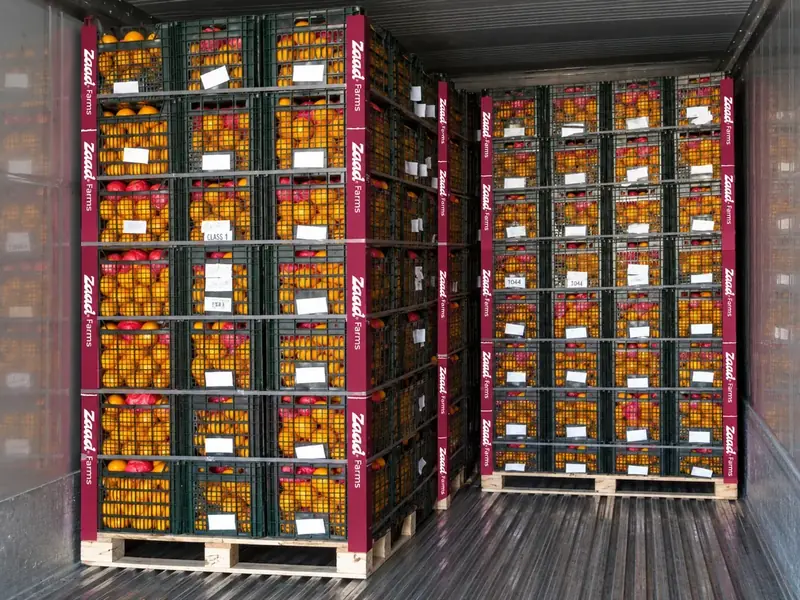
Quick answer: fresh produce from Egypt is shipped mainly from Alexandria, Damietta and Port Said on the Mediterranean and from Sokhna on the Gulf of Suez. Typical reefer transit is about 3–7 days to Italy and the eastern Mediterranean, 7–14 days to Northern Europe and the UK, 7–12 days to Russia’s Black Sea ports, 4–10 days to Red Sea ports in Saudi Arabia, and 3–4 weeks to East Asia. These are indicative ranges; the actual time depends on the service, any transhipment and current conditions on the route, so always confirm the schedule with the line.
Why Egypt is well placed for fresh produce
Egypt has coastlines on both the Mediterranean and the Red Sea and controls the northern entrance to the Suez Canal. For fresh produce this means short sailing distances to Europe and the Middle East, direct services to many Mediterranean ports and good connections through transhipment hubs to Asia and the Americas. For perishable crops such as citrus, grapes, strawberries and vegetables, every day saved at sea means more shelf life at the destination, which is why port choice and routing deserve as much attention as price.
The main export ports
| Port | Coast | Typical role for produce |
|---|---|---|
| Alexandria (including El Dekheila) | Mediterranean | Main hub for citrus, potatoes, onions and mixed reefers to Europe, Russia and the Middle East |
| Damietta | Mediterranean | Strong container and reefer services, close to Nile Delta farms |
| Port Said (East and West) | Mediterranean / Suez Canal | Large transhipment hub with connections to Asia, the Americas and the Gulf |
| Sokhna | Gulf of Suez | Services towards the Red Sea, the Gulf and the Indian Ocean |
| Safaga and Red Sea ports | Red Sea | Regional services, mainly to Saudi Arabia and the Gulf |
The best port is usually the one closest to the packing house that has a weekly direct service to your destination, so ask your forwarder for the available sailings before you finalise the order. Our guide to air versus sea freight explains when a faster mode is justified.
Indicative transit times by destination
| Destination | Typical sea transit | Notes |
|---|---|---|
| Italy, Greece, Turkey, Spain | 3–7 days | Frequent direct services; often the shortest routes |
| Netherlands, Germany, Poland, UK | 7–14 days | Direct or via transhipment; check the arrival port and inland transport |
| Russia (Novorossiysk and Black Sea ports) | 7–12 days | Depends on the service and current regional conditions |
| Saudi Arabia (Jeddah) | 4–10 days | Short Red Sea routes from Sokhna or Safaga |
| UAE, Qatar, Kuwait | 12–20 days | Longer sailing via the Red Sea and Arabian Sea, or via transhipment |
| India, Singapore, Malaysia | 15–28 days | Via Red Sea and Indian Ocean; depends on transhipment |
| East Asia (China, Korea, Japan) | 22–35 days | Suitable for long-keeping crops such as citrus, pomegranates and onions |
| US and Canada East Coast | 14–24 days | Transatlantic or via a European hub; check market access rules |
These ranges are indicative and come from typical liner services. They are not guarantees, and a quoted transit time should always be confirmed by the shipping line before booking.
Which crops suit which routes
Match the crop to the sailing time. Long-keeping crops such as oranges, pomegranates, onions and potatoes handle 3–5 weeks in a properly set reefer and can serve Asia and distant markets. Sensitive crops such as strawberries, lettuce and delicate grapes are best on routes under about ten days, or by air. Our seasonal calendar shows when each crop is at its best, and our reefer temperature guide lists the settings to use on longer routes.
Suez Canal and Red Sea conditions
Routes that pass through the Suez Canal and the Red Sea are affected by security conditions, canal traffic and decisions by individual shipping lines. In recent years some lines have rerouted vessels around Africa at various times, which increases transit time and can change which services call at Egyptian ports. For Egyptian exporters the practical consequence is that a transit time on paper can differ from reality. Before you book, ask your forwarder or line for the current routing, the number of days actually being delivered and any surcharges, and build a reasonable buffer into your arrival plan for perishable cargo.
Direct service or transhipment
A direct service is usually faster and gentler on the cold chain, because the container is not lifted and stored in an intermediate port. Transhipment can open more destinations and sometimes lower rates, but it adds handling, waiting time and risk, especially for fruit that is already near the end of its storage life. For sensitive crops, a direct service is normally preferred, and for robust crops transhipment can be acceptable. Whichever you choose, ask for the temperature monitoring to be active on every leg.
Booking tips
- Check cut-off times: containers must reach the terminal before the vessel closes, and a missed cut-off can cost a week.
- Agree who books the vessel in the contract, as explained in our guide to FOB, CFR and CIF.
- Confirm free days at the destination port, to avoid demurrage and detention charges.
- Ask for the container to be pre-cooled and loaded correctly; see our guide to loading a reefer.
- Keep the documents ready before sailing, as described in our guide to export documents.
Choose the route by how long the crop can keep, not only by the price of the freight.
Plan your shipment with Zaad Farms
Tell us the product, volume and your destination port, and we will suggest the Egyptian loading port and the most suitable service. See our grapes, lemons and other products for the packing formats available on each route.
Frequently asked questions
Which Egyptian ports ship fresh produce?
Mainly Alexandria, Damietta and Port Said on the Mediterranean and Sokhna on the Gulf of Suez, with some regional services from Safaga and other Red Sea ports.
How long does a reefer take from Egypt to Europe?
Typically 3–7 days to Italy, Greece and Spain and about 7–14 days to Northern Europe and the UK, depending on the service and transhipment.
Which crops can go to East Asia by sea?
Long-keeping crops such as citrus, pomegranates and onions, in a correctly set reefer. Delicate crops such as strawberries are better suited to shorter routes or air freight.
How do Suez and Red Sea conditions affect shipping?
Security and canal conditions can change routings and transit times. Always ask the line or forwarder for the current schedule and add a buffer for perishable cargo.
Is a direct service better than transhipment?
For sensitive crops a direct service is usually better, because it avoids extra handling and waiting. Robust crops may accept transhipment.
Can Zaad Farms recommend a loading port?
Yes. Send us your product, volume and destination, and we will suggest the most suitable port and service.