
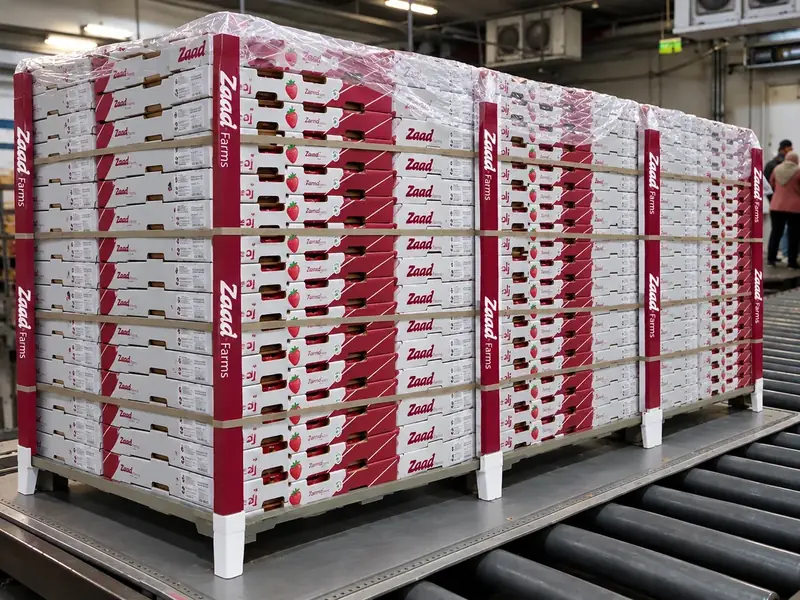
Egyptian strawberries fill the European winter: the season runs from December to May, with a peak from January to March. Strawberries are one of the most perishable products we export, so the way they are handled in the first hours after picking decides how they look on the shelf.
Varieties
Egyptian growers use several short-day varieties. Depending on availability, you will see Festival, Fortuna, Sensation, Florida, Frontina and Singa. Each has its own balance of size, firmness, colour and flavour. Rather than committing to a single variety, most programmes specify the eating and appearance characteristics they need and let the variety follow the season.
Size and grade
- Size: typically 25–35 mm diameter for fresh retail.
- Grade: Class I or buyer specification.
- Colour: fully red, or ¾ red for longer voyages — agree which.
- Calyx: green and fresh; no dry or brown calyx.
- Tolerances: soft fruit, bruising, misshapen fruit and decay.
Field-packed punnets
To reduce handling, fruit is picked and packed directly into punnets in the field. Every extra touch damages strawberries, so packing at the point of harvest keeps the fruit firmer and cleaner. Standard formats are 225 g, 250 g and 400 g punnets in printed master cartons. Private label, label language and barcodes are agreed in advance.
The first hours: pre-cooling
Strawberries continue to respire after picking and warm fruit deteriorates quickly. After harvest, pallets go through forced-air cooling to bring the fruit down to around 0–1 °C as fast as possible. From there, the cold chain must not break: loading, transport and arrival all at 0 to +1 °C and 90–95% relative humidity.
Air or reefer?
| Air freight | Sea reefer | |
|---|---|---|
| Transit | 1–2 days | Several days, depending on port |
| Freshness on shelf | Highest | Good on short routes |
| Cost per kg | High | Low |
| Best for | Premium retail, distant markets | Markets within a few days’ sailing |
Many buyers combine both: air freight for the start of the season and promotional weeks, reefers for regular volume to nearby markets. Our freight guide compares them in detail.
Fresh and frozen from the same fields
Fruit that does not meet fresh retail specifications, or that is grown for processing, goes into our IQF frozen strawberries. This lets a buyer source fresh fruit in season and frozen fruit year-round from the same origin.
With strawberries, the specification matters, but the hours between picking and pre-cooling matter more.
Specifications and availability are on our Egyptian fresh strawberries page. For retail programmes, see strawberries and grapes for retail.
Frequently asked questions
When are Egyptian strawberries in season?
From December to May, with a peak from January to March.
Which strawberry varieties are grown in Egypt?
Depending on availability: Festival, Fortuna, Sensation, Florida, Frontina and Singa.
What punnet sizes are available?
225 g, 250 g and 400 g punnets in printed master cartons; other sizes on request.
Should strawberries go by air or sea?
Air for maximum freshness and distant markets; reefers for markets within a few days’ sailing.