
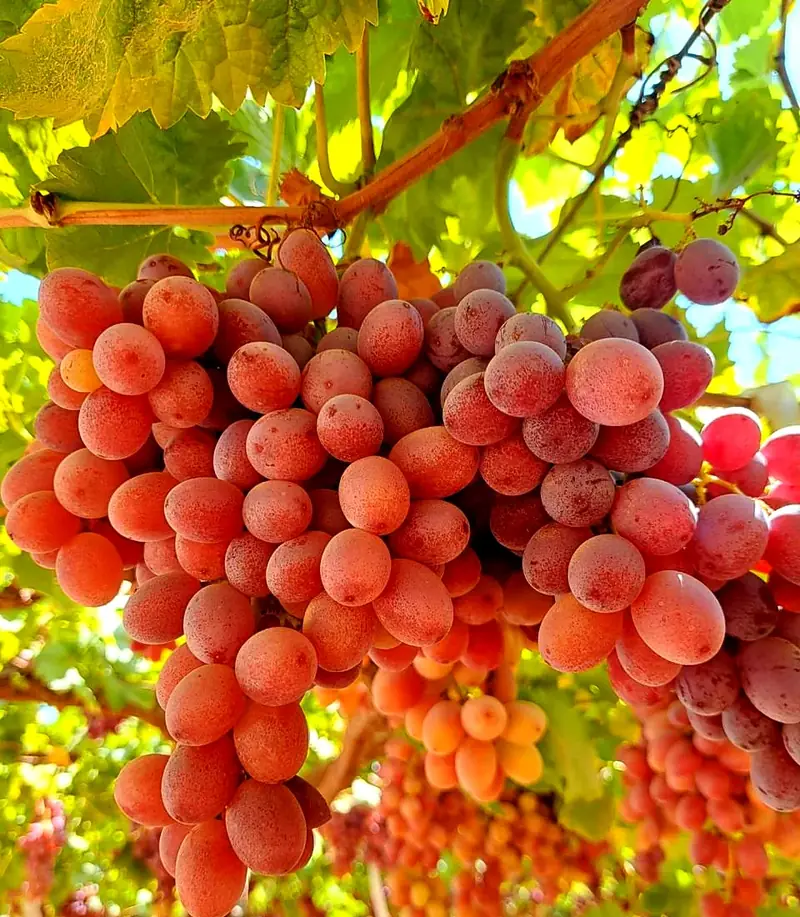
Egyptian grapes reach Europe early in the Northern Hemisphere season, often weeks before other origins. That early window is the main reason retailers build Egyptian grape programmes. From May to October, a succession of white, red and black varieties can keep the shelf supplied.
Variety calendar
| Variety | Colour | Window | Notes |
|---|---|---|---|
| Early Sweet | White, seedless | May – June | Opens the season |
| Superior Seedless | White, seedless | May – July | Crisp; main early export |
| Flame Seedless | Red, seedless | June – July | Sweet and crunchy |
| Red Globe | Red, seeded | July – September | Large berries; Asia and Gulf |
| Crimson Seedless | Red, seedless | August – October | Late; good storage |
| Autumn Royal | Black, seedless | August – October | Large black berries |
Peak volumes are usually in June and July, when Superior and Flame overlap. Exact dates depend on the vineyard and the year, so we confirm availability per shipment week.
What to specify
- Berry size — expressed as minimum berry diameter in millimetres (for example 16 mm+ or 18 mm+). Larger berries command higher prices.
- Brix — sugar content. A minimum Brix protects against early, sour fruit; agree the level and measurement method.
- Bunch weight and shape — important for punnet filling and presentation.
- Colour — for red varieties, the percentage of well-coloured berries.
- Stem condition — green, fresh stems signal a short time since harvest.
- Tolerances — loose berries, shatter, splits and decay.
Packing formats
- 250 g or 500 g punnets or clamshells in master cartons, labelled with your brand and barcode.
- 5 kg bulk carton with liner for wholesale and repacking.
- SO₂ pads and liners where specified, to control grey mould on longer voyages.
Cold chain: grapes need speed
Grapes lose water quickly, which shows as brown, dry stems. The key is fast cooling after harvest, typically with forced-air cooling, and then a stable temperature of −0.5 to 0 °C at 90–95% relative humidity. The ventilation strategy is confirmed per programme. Grapes should never be mixed with products that release ethylene or need a warmer set-point.
Sea or air?
Most programmes travel by sea. Air freight is useful for the first weeks of the season, when being on the shelf early is worth the cost. See our air vs sea guide for the trade-offs.
Residues and SO₂
Retailers often set their own residue limits below legal MRLs, and the use of SO₂ pads must match your market’s rules and labelling. Share your requirements before the season so the vineyard programme and packing materials can be aligned. More in our MRL and documents guide.
Egyptian grapes win on timing. A clear berry-size and Brix specification makes sure the early fruit also wins on eating quality.
See current varieties and specifications on our Egyptian table grapes page and our retail guide to strawberries and grapes.
Frequently asked questions
When does the Egyptian grape season start?
Usually in May with Early Sweet and Superior Seedless, continuing to October with Crimson and Autumn Royal.
What is the main Egyptian export grape?
Superior Seedless, a crisp white seedless grape, is the main early-season export variety.
What temperature should grapes be shipped at?
Typically −0.5 to 0 °C at 90–95% relative humidity, after fast pre-cooling.
Are SO₂ pads used?
Where specified by the buyer and allowed in the destination market, to control grey mould on longer voyages.